
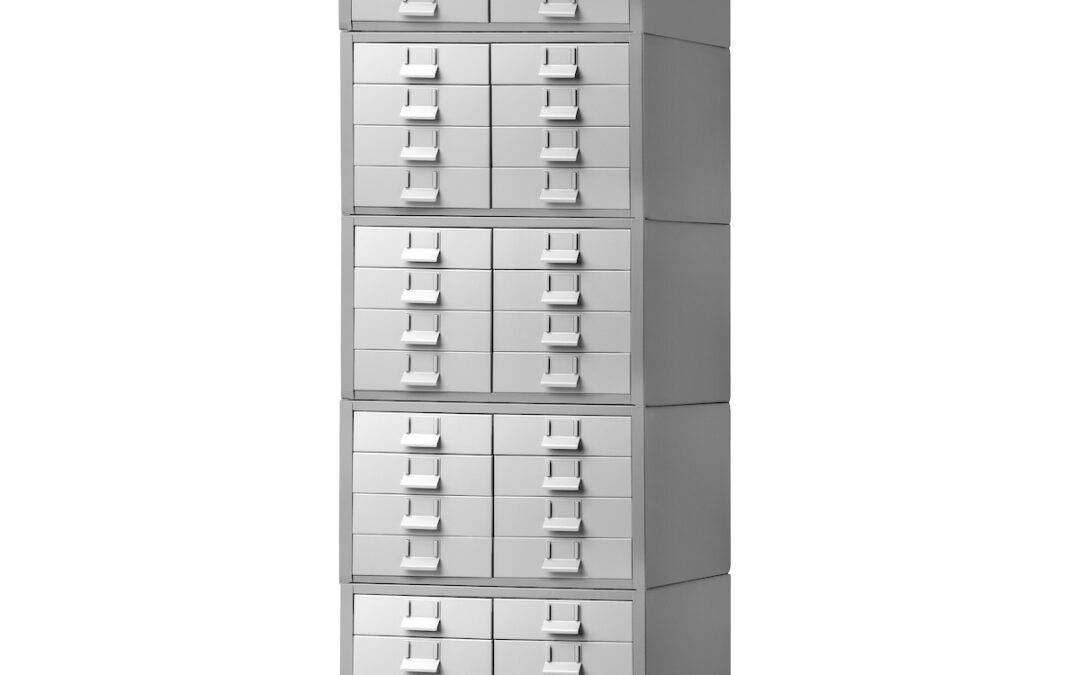
A tissue block storage plan should answer a practical question: how much usable space will your lab need before the next planned expansion? Looking only at today’s empty drawers can leave purchasing decisions until the archive is nearly full.
Start with your current inventory and actual growth. Then compare that demand with the usable capacity of the cabinets, drawers, or storage units you are considering. A written estimate makes it easier to explain the purchase and choose when to order.
Count What Is Already Stored
Include every location, including overflow shelves and temporary filing areas. Record how many blocks are stored and which cassette or block formats are present. Separate formats that need different storage arrangements rather than treating every item as the same size.
Check whether existing capacity figures reflect the way your lab actually files material. Dividers, reserved sections, and unusual block sizes may affect how much space is usable. A product’s advertised maximum is a starting point to verify, not a substitute for a layout check.
Use Monthly Additions to Estimate Demand
Review recent filing records and identify the number of blocks added each month. If volume changes throughout the year, use several months of data and consider both a typical month and a busier scenario.
For illustration, an archive holding 18,000 blocks that adds 750 per month would need 27,000 positions after one year if no blocks leave the archive. That is 18,000 current blocks plus 9,000 new blocks.
This example is a capacity calculation, not a retention recommendation.
Account for Retention and a Planning Buffer
Only subtract material that your lab is authorized and scheduled to remove under its applicable retention requirements. An expected disposal date should not be treated as available space until the responsible team confirms the plan.
Choose a capacity buffer based on the uncertainty in your forecast and how long an expansion takes. For example, adding an illustrative 10 percent buffer to 27,000 positions produces a target of 29,700.
Your lab may need a different allowance; there is no universal percentage for every archive.
Translate the Estimate Into a Room Plan
Once you have a target capacity, compare storage configurations that accommodate your block formats. Check the footprint, access clearance, load limits, and installation instructions for each option.
Consider the route into the room as well. Doorways, elevators, and receiving space can affect delivery and installation. Ask which accessories are included and whether future units can be added in the location you have chosen.
Set a Trigger for the Next Purchase
Decide when the lab should review capacity again. One practical approach is to compare remaining positions with the expected additions during the time needed to select, order, receive, and install more storage. Include your chosen buffer in that decision.
Update the estimate when specimen volume or retention plans change. A small recurring review can be easier to manage than finding an emergency overflow area.
Explore Tissue Block Storage at LabStore
LabStore’s tissue cassette storage selection includes modular drawers, corrugated storage units, tissue block cabinets, and high-density cabinets.
Use your inventory and room plan to compare suitable configurations and confirm their usable capacity before ordering.