
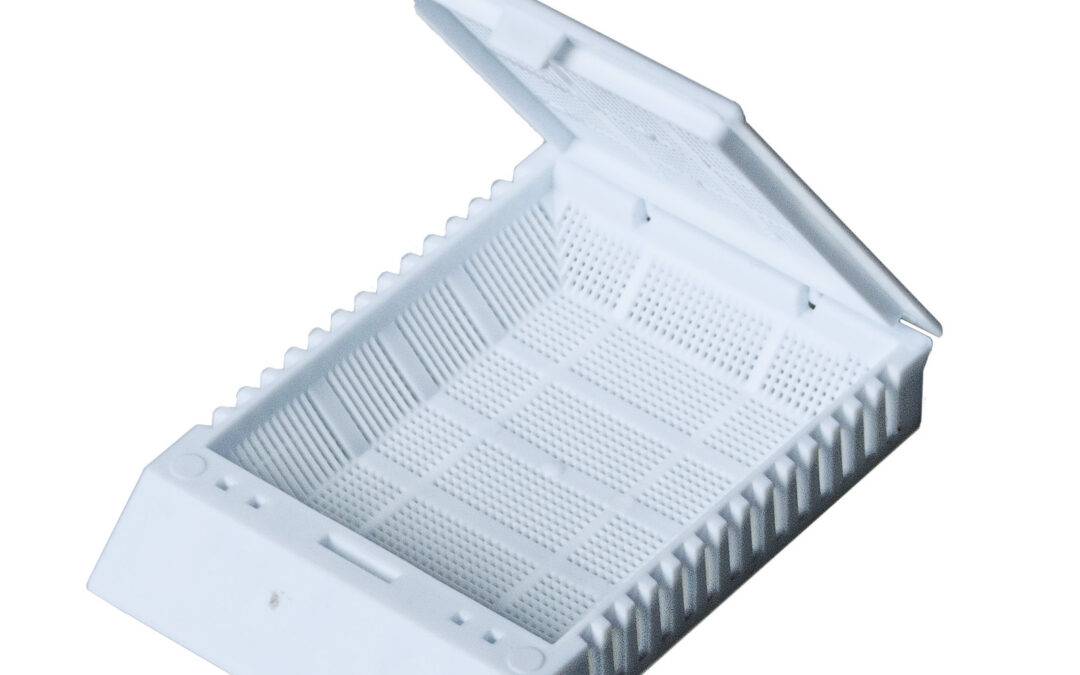
Tissue cassettes and biopsy cassettes both hold tissue during histology processing. The main purchasing question is whether a particular cassette can contain the intended specimen while allowing processing fluids to pass through. Product names alone are not enough to make that decision.
Biopsy cassettes are designed with small specimens in mind, while tissue cassette categories include formats for a range of routine and larger specimens. The opening size, internal dimensions, and intended use of the exact model should guide selection.
Look at the Specimen and the Openings Together
A cassette’s openings are part of its containment design. Compare the manufacturer’s stated opening dimensions with the specimens your lab expects to process, using your laboratory’s validated procedures.
Do not assume that every cassette described as a biopsy cassette has the same mesh or perforation size. Likewise, two tissue cassettes that look similar from the outside may differ in internal space or lid design.
Compare the specifications of each product number rather than relying on a category photograph.
Compare Internal Space and Compartments
Internal dimensions determine the usable space available to your team. A divided cassette also changes how that space is arranged. Check the size of each compartment rather than considering only the outside dimensions.
LabStore’s biopsy cassette selection includes single-compartment models as well as four-compartment Micromesh and six-compartment Microsette options.
Multiple compartments should serve a defined purpose in an approved workflow, with a documented way to preserve specimen identity. They are not a reason to combine specimens that need separate handling.
Check Accessory Requirements Separately
Some workflows use biopsy pads or inserts, while certain cassette designs are intended for use without them. Confirm the requirements for the exact product and specimen application. An accessory used with one cassette should not automatically be carried over to another.
When considering a switch, document what changes: the cassette, lid, retention accessory, loading method, or more than one component. Give the technical team a complete comparison so it can evaluate the proposed setup before routine use.
Review Labeling and Equipment Fit
Both tissue and biopsy cassette orders should include a compatibility check. Confirm the labeling surface and the format supported by your specific cassette printer. Review how the cassette fits processor baskets and other equipment used in your lab.
Packaging matters too. Loose cassettes, attached lids, separated lids, and printer-oriented formats are not interchangeable purchasing details. The selected configuration should match the way staff load and use the product.
Create a Clear Ordering Reference
For each approved cassette, record its product number, intended specimen application, color, lid arrangement, accessory requirements, and package quantity.
Keep this reference available to purchasing staff so a routine reorder does not introduce an unintended substitution.
If evaluating alternatives, compare the complete cost per usable cassette, including any required lids or inserts. A lower case price may reflect a different quantity or configuration.
Find the Right Cassette Category at LabStore
Browse LabStore’s tissue cassettes and biopsy cassettes to review the available formats.
Start with the specimen requirements, confirm the exact specifications, and follow your lab’s evaluation process before changing an approved product.